Meanwhile, Down Your High Street: The Winter Warm Rooms Opening Where Shops Used to Be
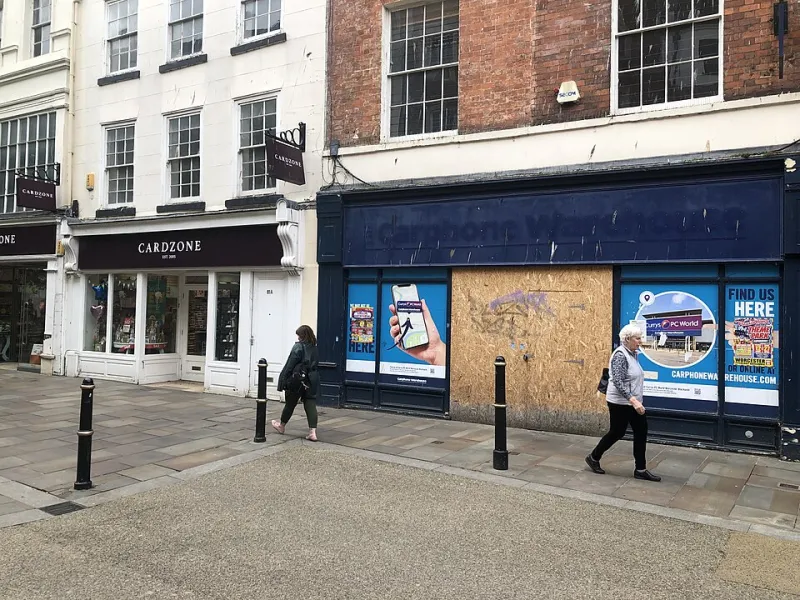
Photo: Richard Webb , CC BY-SA 2.0, via Wikimedia Commons
There is a unit on my high street that used to sell picture frames. Then it sold phone cases. Then it sold nothing at all, and for the best part of two years the only thing in the window has been a sun-bleached leaflet for a gym that shut in 2024. Last Tuesday, at half nine in the morning, there was a kettle in there. Also an urn, a stack of mismatched chairs and eleven people in coats, disagreeing pleasantly about whether the Christmas lights should go up before or after the school fair.
The shop is now a warm room. It opens on Wednesdays and Saturdays until the end of February. Nobody is selling anything.
The most useful square footage in town
Every UK high street has a version of this unit. You know the ones: the plywood panel with a letting agent's mobile number, the peeling TO LET, the drift of post behind the glass. People argue about the exact vacancy figures, but nobody who walks to the post office needs the statistic. You can count them yourself in four minutes.
What has changed — slowly, and then quite quickly — is what communities are doing with them in the gap between one tenant and the next. Meanwhile use, the official term, used to mean a pop-up tat shop for six weeks in December. In winter 2026 it increasingly means a warm room: somewhere heated, with a kettle, a table and no expectation that you buy anything.
The economics are not complicated. A landlord with an empty unit starts paying business rates again once the initial relief period runs out, and an empty building decays — pipes, damp, insurers getting twitchy. A three-month licence at a peppercorn rent to a group of insured volunteers is not a fortune, but it stops the rot. It also stops the loneliness. Those two problems turn out to be closely related.
Three Toect projects to look out for
The Old Drapery, Wrexham. A former fabric shop, now Warm Wednesdays, 10am to 2pm. Soup, tea, and a table with jigsaws nobody finishes. Organiser Bethan says the rule is simple: no programme, no sign-in sheet, no leaflets about your five-a-side team unless someone asks. They had sixty visits in the first fortnight, mostly people over seventy and almost all of them on foot.
Unit 7, Cleethorpes. Saturdays are a repair café, Sundays a knit-and-natter, and there is a shelf by the door where you can leave a working kettle and take a working kettle. The volunteers fixed forty-three items in October — lamps, a strimmer, one accordion. Sorting the insurance took three weeks and they wish they had started it in September.
The former betting shop, Paisley. The most festive of the three. Saturday workshops run through December: wreaths from hedge clippings, cards from last year's wrapping paper, and a bring-your-own-broken-fairy-lights amnesty. The back room is a quiet warm room with blankets, no workshop, and no talking required.
All three are Toect members, and all three will tell you the same thing. The building is the easy bit. The rota is the hard bit.
How to ask a landlord (without scaring them off)
Find out who owns the place. The council's empty property officer usually knows; the Land Registry will tell you for £7; the agent's board is a start. Then write one page. Not a business plan — one page with four lines: what you want to do, when, who is insured, and who to ring if something goes wrong.
Ask for a licence rather than a lease: a three-month meanwhile arrangement with a break clause. Offer to cover the utilities, the contents insurance and a small weekly sum. Then ask what the owner is worried about and answer it in writing. Landlords tend to fear three things — squatters, fire, and being stuck with you. Address all three and most of them relax visibly.
The council side of things
Ring the council before you ring the landlord. Most authorities now have someone whose actual job title involves empty shops, and they can talk you through discretionary rate relief, small community grants, and whether the unit is listed as an Asset of Community Value. Your ward councillor is also useful, and is rarely asked.
Then do the dull safety things properly: a fire risk assessment, public liability insurance, PAT testing on any donated electricals, food hygiene if you are serving anything beyond a biscuit, and a safeguarding policy if children or vulnerable adults will be around.
Your starter checklist
- Identify the owner, the unit and its rateable value
- Speak to the council's empty property officer
- Draft a one-page proposal: purpose, dates, insurance, contact
- Agree who holds the key and who holds the spare
- Public liability insurance in place before day one
- Fire risk assessment and a clear, unlocked escape route
- PAT test every donated appliance
- Two named first aiders and a stocked kit
- Food hygiene certificate if hot food is involved
- A rota for opening, closing, the kettle and the cleaning
- A cash-free donations tin, and a firm rule about not becoming a shop
- Tell the neighbours on both sides what you are doing, and when
What we are asking for this winter
The Toect noticeboard is full of people looking for exactly this: a warm room, a spare hour, and someone to drink tea with. If you have a boarded-up unit and a free afternoon, put it on the listings page. If you have a spare kettle, say so. If you are the person in your street who organises things, we would love to hear how the first week went — the good bits and the boring bits, including the rota.
The picture-frame shop on my high street opens again on Saturday. I have been asked to bring a cloth for the tables. It is the most useful I have felt in weeks.